Thesis: The apartment in contemporary cinema should not be understood as a neutral domestic setting, but as a closed perceptual system in which space, image, and mediation continuously reorganise one another. Its psychological intensity does not arise from narrative events alone, but from the way repetition, framing, and technological mediation transform a stable interior into an unstable field of perception.
An apartment is often approached in cinema as a neutral container for narrative action—a domestic backdrop that supports character and plot. However, within certain contemporary film practices, the apartment can be reconsidered as something closer to a closed perceptual system: a space that does not simply host behaviour, but actively records, accumulates, and reorganises it over time.
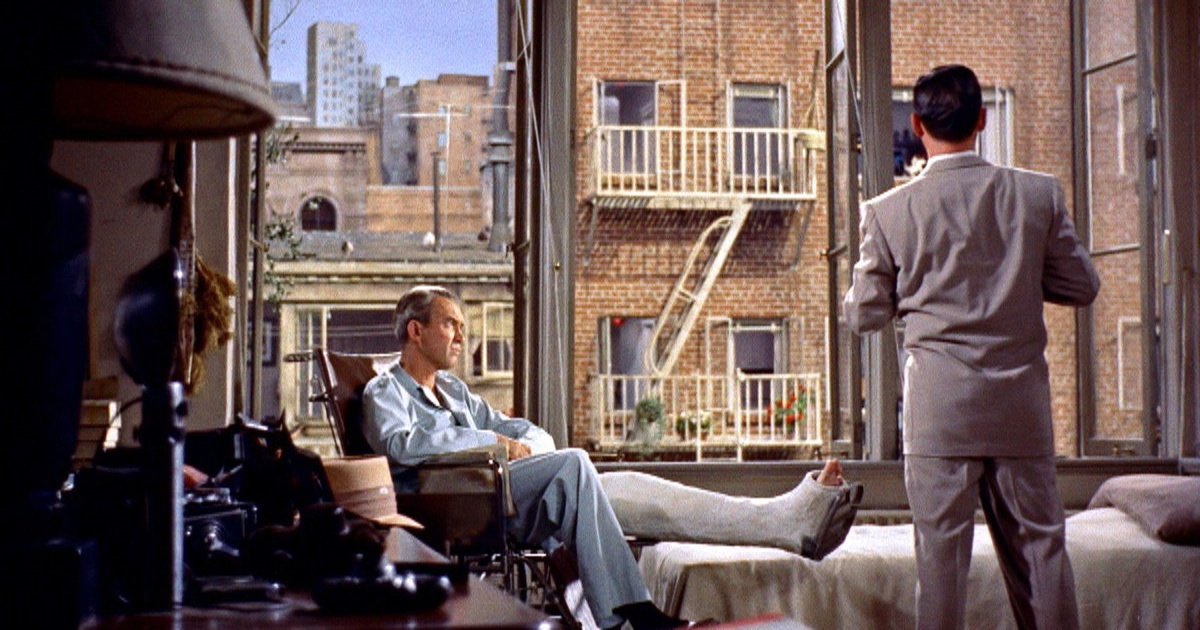
This idea is visible across a range of cinematic works. In Roman Polanski’s Repulsion (1965), the apartment becomes a collapsing mental architecture where interior space reflects psychological disintegration. In Alfred Hitchcock’s Rear Window (1954), the apartment is transformed into a surveillance apparatus, where looking itself reorganises the meaning of domestic space. More recently, films such as Bong Joon-ho’s Parasite (2019) and Joachim Trier’s The Worst Person in the World (2021) use domestic interiors to register class tension, emotional drift, and perceptual fragmentation. In each case, the apartment is not simply a setting but a system that produces meaning through constraint.
From this perspective, the apartment is less a “set” in the traditional sense and more a condition. It is a bounded environment in which repetition, proximity, and duration begin to alter how space is perceived. What appears stable at the level of architecture becomes unstable at the level of experience. The apartment does not change physically, but it becomes psychologically re-coded through use.
A key shift occurs when the apartment is no longer understood as a unified interior, but as a field of relations between bodies, objects, and durations. The question is no longer what happens in the space, but how the space changes the legibility of what happens. In other words, the apartment does not merely contain action—it filters and reframes it.
This can be observed at the level of basic spatial elements. A doorway may begin to function as a perceptual threshold—marking hesitation, avoidance, or emotional discontinuity. A corridor may register as delay or distance. A kitchen table may shift from a functional surface to a site of confrontation or silence. Spatial elements acquire psychological functions without undergoing any material transformation.
This approach aligns with a broader tendency in cinema that treats interior space not as background, but as an active participant in the construction of meaning. The apartment becomes a site where perception itself is tested under conditions of restriction. Because the space is limited, every variation in behaviour becomes amplified, and every repetition begins to accumulate meaning.
The Home as a Closed Image System
In contemporary conditions, the apartment can no longer be understood as fully sealed. It is structurally connected to external flows of information through screens, devices, and recording technologies. These elements do not simply exist within the home; they function as apertures through which the outside continuously enters.
This condition is central in films such as David Fincher’s The Social Network (2010), where domestic and semi-private interiors are constantly penetrated by digital communication, or in Steven Soderbergh’s Unsane (2018), where the smartphone camera collapses the boundary between lived space and recorded space. The apartment becomes a hybrid structure: simultaneously interior and interface.
Within such a system, the distinction between lived experience and mediated representation becomes increasingly unstable. Actions inside the apartment are not only performed; they are potentially recorded, framed, transmitted, or recontextualised. A gesture may shift meaning once it is captured. Even absence can become legible through its documentation.
A simple domestic interaction—two people speaking in a room—changes its ontological status once a camera is introduced. The conversation is no longer only an event; it becomes material that can be replayed, interpreted, or detached from its original emotional context. This logic is already present in Rear Window, where the act of looking transforms private life into narrative construction.
Importantly, the camera is not external to this condition. It participates in it. Rather than simply recording space, it reorganises attention within it, privileging certain relations while obscuring others. Visibility becomes a form of structuring reality rather than reflecting it.
This raises a central question for contemporary cinematic space: at what point does representation cease to describe an environment and begin to actively reorganise it? Within the apartment, this threshold is difficult to locate, precisely because the space itself appears stable.
Limitation as Spatial Method
Single-location cinema is often discussed in terms of constraint, but it can also be understood as a methodological choice that intensifies spatial perception. Films such as Sidney Lumet’s 12 Angry Men (1957) demonstrate how a single interior space can generate escalating psychological tension through repetition and variation of positioning. More recently, Locke (2013) by Steven Knight confines its entire narrative to a car interior, showing how even minimal space can become structurally expressive.
In such conditions, repetition becomes structurally significant. Returning to the same room does not produce sameness; it produces recontextualisation. A room that once registered as neutral may later feel charged, not because it has changed, but because memory has been inscribed onto it through repetition.
The apartment becomes stratified by memory, even when nothing visible remains. Space is never reset; it is continuously overwritten without erasure.
Objects, Mediation, and Intrusion
Domestic objects typically recede into invisibility through familiarity. Cinema has the capacity to reverse this condition. In Parasite, objects such as the hidden basement space or everyday household items become carriers of structural tension between social worlds. In Her (Spike Jonze, 2013), the absence of a physical body for the operating system transforms the apartment into a space defined by mediated presence.
Objects do not necessarily operate as symbols. Their significance lies in their capacity to disrupt categorical stability. A mediated object—such as a screen, a recording device, or even a staged prop—can introduce ontological friction when placed inside a domestic environment.
Phones and screens function differently. Rather than occupying space, they extend it. They introduce external presence without physical entry, allowing events occurring elsewhere to reorganise the affective conditions of the room in real time. Much of contemporary cinema, from Unfriended (2014) to Searching (2018), is built entirely on this principle: the apartment is no longer sealed, because externality arrives through interface.
As a result, the space becomes populated not only by objects and bodies, but by absences that are actively operative—delayed responses, unseen events, and implied presences that shape behaviour without appearing directly.
Stability, Perception, and Re-reading
The central issue is therefore not spatial transformation in a physical sense, but perceptual instability under conditions of repetition and mediation.
The apartment does not need to change in order to become unstable. Its instability emerges through accumulated re-reading. Each return to the same space carries residual traces of previous events, even when those events are no longer visible.
What appears at first as a stable domestic interior gradually reveals itself as a system in which meaning is not located in space itself, but in the ongoing processes through which space is perceived, recorded, and reinterpreted.